
Does your family have a coat of arms? How surnames connect to arms
Search your surname online and you’ll almost certainly find a neat shield with a motto beneath it, and perhaps a paragraph explaining what the colours say about your family. It’s often the first thing people see when they grow curious about their name. It’s also built on an idea heraldry never supported: that a coat of arms belongs to a surname, and that everyone who carries the name inherits it.
The truth is more interesting, and it’s worth knowing before a design goes on a ring you’ll wear for the rest of your life.
Arms belong to people, not names
A coat of arms was granted to one person, usually by the Crown or an official heraldic authority, and often in recognition of service or standing. From there it passed down that person’s line according to the law of arms, traditionally through legitimate male descendants. It did not spread sideways to everyone who happened to share the name.
That’s why a common surname can’t point to a single coat of arms. Smith was taken up independently by thousands of unrelated families of smiths. O’Brien descends from several distinct branches with different histories. Somewhere along the way, individual Smiths and individual O’Briens were granted arms, but those arms belonged to that person and his descendants, not to the name as a whole.
(If the difference between a crest and a coat of arms is new to you, our guide What is a crest? explains it.)
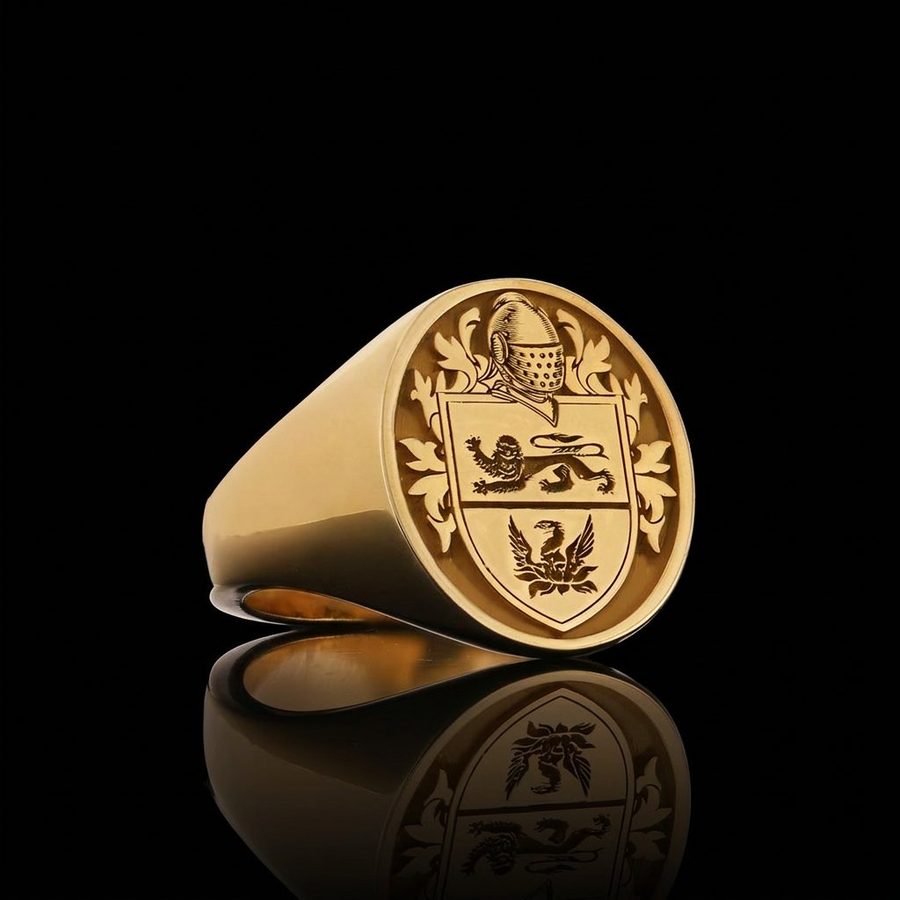
How arms pass from father to son
Once arms had been granted, heralds faced a practical problem. If a man had three sons, they couldn’t all carry an identical shield, because the whole point of heraldry was to tell one knight from another. So each tradition developed its own way of handing arms down without blurring them.
In England the answer was cadency. While his father lived, the eldest son added a label, a narrow band with three points across the top of the shield, to show he was the heir. On his father’s death he took the arms unmarked. Younger sons added small marks of their own: a crescent for the second son, a mullet (a five-pointed star) for the third, a martlet (a small bird without feet) for the fourth, an annulet (a ring) for the fifth and a fleur-de-lis for the sixth. A herald could look at a shield and know exactly where its owner stood in the family.
Scotland is stricter. A coat of arms there belongs to one person, and younger branches must have their own version formally recorded, or matriculated, by the Court of the Lord Lyon, usually with a coloured border to set it apart. Scotland also has the clan system. Many surnames, known as septs, were historically linked to a clan chief through kinship, loyalty or protection rather than direct descent. Members of a clan don’t inherit the chief’s arms, but they may wear his crest inside a strap and buckle as a badge of belonging.
In Ireland, arms followed the branches of the great families. As a clan grew and divided across different territories, each branch kept the core of the family’s arms and changed a detail, such as a border, a colour or an added charge.
How to research the arms recorded for your name
A surname is still where every search begins. It’s the thread that leads you back to the particular ancestor whose arms you’re looking for.
Two reference works have guided researchers for well over a century. Burke’s General Armory, compiled by Sir Bernard Burke, Ulster King of Arms, lists the arms of tens of thousands of families across England, Scotland, Ireland and Wales. Fairbairn’s Book of Crests does the same for crests alone, which makes it especially useful for signet rings. The official registers of the College of Arms in London, the Court of the Lord Lyon in Edinburgh and the Office of the Chief Herald of Ireland in Dublin remain the final word on genuine grants.
Be patient with spelling. Surnames shifted with dialect, literacy and whoever was holding the pen, so a search for Kavanagh should include Cavanagh, and Mackay may appear under its Gaelic form, Mac Aoidh. Families who emigrated often appear in the records under an older spelling than the one they use now.
When you do find an entry, read the written description, called the blazon, rather than relying on the picture beside it. “Gules, a lion rampant Or” means a gold lion standing on its hind legs on a red shield. The blazon is the actual record. A drawing is one artist’s interpretation of it, and drawings vary while the blazon stays the same.
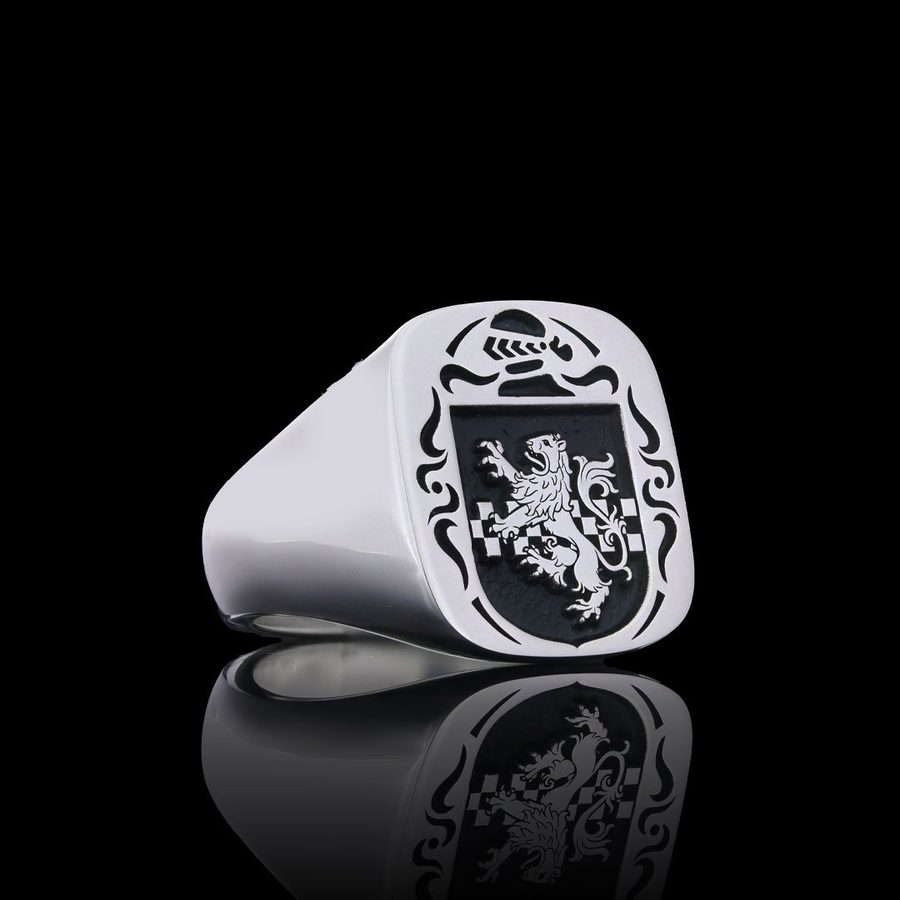
What this means for your ring
If you can trace your line to someone who bore arms, you have something worth engraving exactly as the records describe it, with the correct mark of cadency if one applies to you.
If the arms you’ve found belong to a namesake rather than a proven ancestor, you can still choose to wear them, as many people do, as a link to the history of your name. Just think of them that way rather than as an inheritance. Scottish families have the clan crest badge, which is designed to be worn by everyone who belongs to the clan. And if no arms fit, initials or a design of your own will carry just as much meaning.
At Clanmalier, every ring is made to order. Tell us your surname and anything you know about where your family came from. We’ll look at what the records hold for your name, explain what we find, and prepare a design for your approval before we handcraft the ring.