
What is a crest? Crests and coats of arms explained
Ask most people what a crest is and they’ll describe a shield or a whole coat of arms. Strictly speaking, neither is a crest. In heraldry the crest is one particular part of a coat of arms, and knowing which part makes it much easier to choose a design for a signet ring.
This guide explains what a crest actually is, how it differs from a coat of arms, and how to tell whether your family has arms at all.
What a crest really is
In heraldry, a crest is one specific thing: the figure that sits on top of the helmet, above the shield, in a full coat of arms. It might be a lion’s head, an arm holding a sword, a stag, a bird or a pair of wings.
The crest began as a practical answer to a practical problem. A medieval knight’s helmet covered his face, so in a crowded tournament it was hard to tell one man in armour from another. His shield carried his design at chest height, but knights wanted to be recognised at a distance too. From the 13th century they began fixing carved or moulded figures to the tops of their helmets, a second mark of identity that rose above the crowd.
Over time the crest was recorded alongside the shield and became part of a family’s heraldry. Like the rest of a coat of arms, it was granted to a particular person and passed to his descendants. That is why it feels so tied to ancestry. A crest wasn’t picked from a catalogue. It marked the moment someone was formally recognised, and every generation that carried it afterwards carried that recognition too.
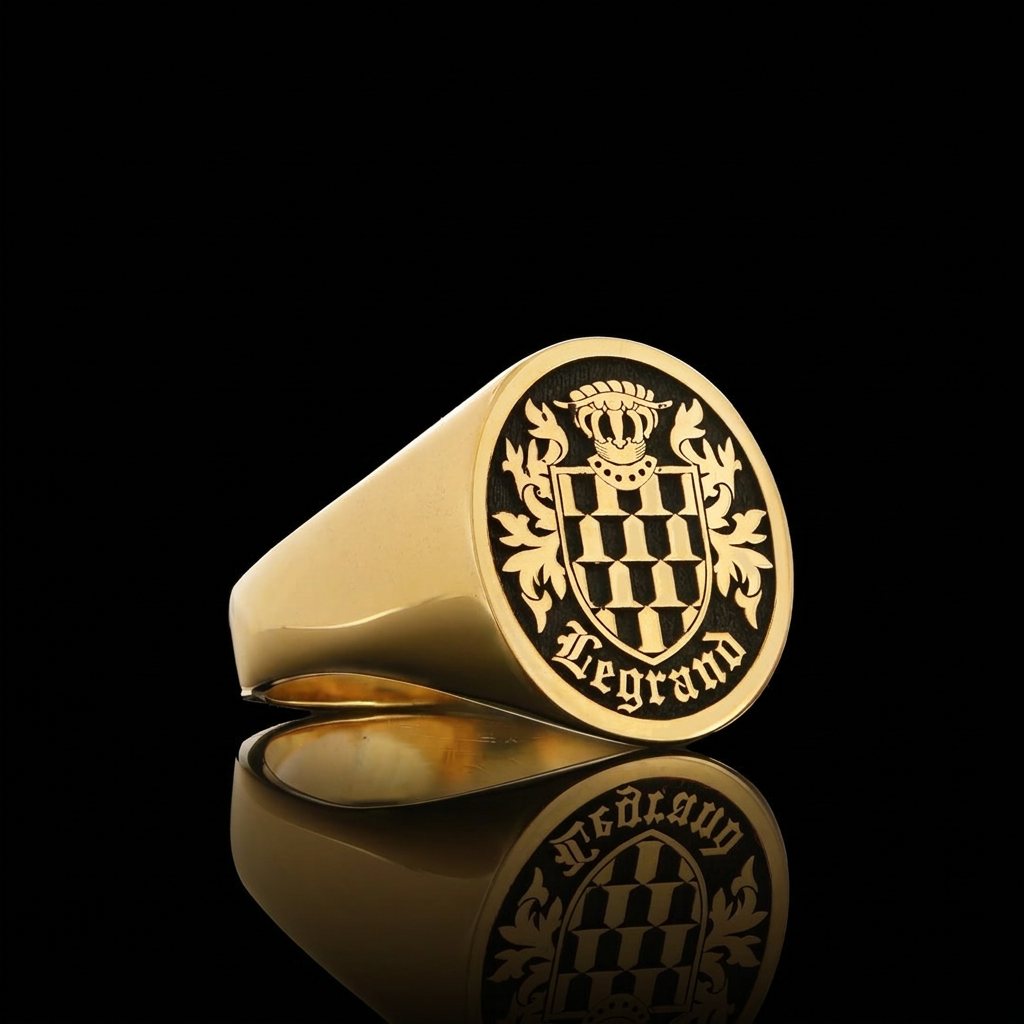
Coat of arms or crest: what’s the difference?
A coat of arms is the whole design, built around the shield. The crest is one part of it. The shield is the oldest and most important part, because its particular arrangement of colours, metals and symbols identified one person. The crest came later and was always secondary.
The two get confused because the crest is often the most eye-catching element. A lion rising above a helmet draws the eye more readily than a shield, so for centuries people have used “crest” to mean the entire design. The habit stuck, and many people still say “crest” when they mean the full coat of arms.
They also did different jobs. The shield told the fuller story, often with several charges (the symbols placed on it). The crest was usually a single bold image, meant to be read in an instant. That difference still matters when it comes to choosing a design for a ring.
The parts of a coat of arms
A complete coat of arms is properly called an achievement of arms. It grew in stages. The shield came first, and the other parts were added over the following centuries as heraldry moved from the battlefield into ceremony and inheritance. Once you know what each part does, a coat of arms stops looking like decoration and starts reading like a record.
- The shield
- The centre of the design and the part that identifies the owner. Its colours, metals and charges are what heralds record and protect.
- The helm
- The helmet above the shield. In British heraldry its style shows rank, with different helmets for the sovereign, peers, knights and gentlemen.
- The wreath, or torse
- A twisted band of fabric in the shield’s main colours, sitting on top of the helm where the crest is fixed.
- The crest
- The figure rising from the wreath, the knight’s second mark of identity.
- The mantling
- The cloth falling from the helm, originally worn over the helmet to keep off sun and rain. In heraldic art it is drawn as sweeping, ragged folds.
- The motto
- A short phrase on a scroll, usually below the shield, expressing a family’s values or an old rallying cry.
- Supporters
- The figures, human or animal, standing either side of the shield as if holding it up. In Britain these are kept for peers, senior knights, Scottish clan chiefs and a few others. An ordinary family can’t simply add them.
- The compartment
- The ground beneath the shield, often grass or rock, on which the supporters stand.
Most coats of arms have just the shield, helm, wreath, crest, mantling and perhaps a motto. Supporters and coronets (small crowns showing a title) belong to the highest ranks.
Does every surname have a coat of arms?
No, and this is where most of the confusion starts. Arms were never granted to a surname. They were granted to an individual, and the right to use them passes to his descendants according to set rules. Two families called Kelly, Smith or Campbell may have no heraldic connection to each other at all. In the Middle Ages a shared surname often didn’t even mean shared ancestry.
So be wary of anything that promises “the coat of arms” for your surname. The arms shown may be perfectly genuine, but there’s a fair chance they belonged to one family who happened to share your name, not to yours.
Each part of the British Isles has its own heraldic authority. In England, Wales and Northern Ireland, arms are granted by the College of Arms in London. In Scotland, the Court of the Lord Lyon in Edinburgh grants and regulates arms, and the rules are strict: using arms you aren’t entitled to is unlawful there. In the Republic of Ireland, the Office of the Chief Herald grants arms and holds records going back centuries, and many Irish families trace their heraldry to the Gaelic clans and their chiefs.
Scotland has one tradition worth knowing about. A clan member who isn’t the chief may wear the chief’s crest inside a strap and buckle carrying the chief’s motto. This crest badge shows belonging to the clan rather than ownership of the arms, and it is an entirely proper thing to wear.
How to find out if your family has arms
Start with genealogy rather than heraldry. Trace your family back generation by generation using real records: parish registers, wills, census returns and land records. Once you can follow a documented line back to a particular person, you can ask whether that person held arms.
The College of Arms, the Court of the Lord Lyon and the Office of the Chief Herald of Ireland all keep historical records and can tell you whether arms were granted and to whom. If you descend directly from someone who bore arms, you may have the right to use them yourself. The rules of inheritance differ between England, Scotland and Ireland, so the heralds are the people to ask.
If the trail runs cold, as it often does, heraldry can still mean a great deal. The arms associated with your surname, a clan crest badge or a symbol tied to your county or country can all be worn honestly, as long as they’re understood as a link to a heritage rather than a claim to a particular line.
Why crests suit signet rings
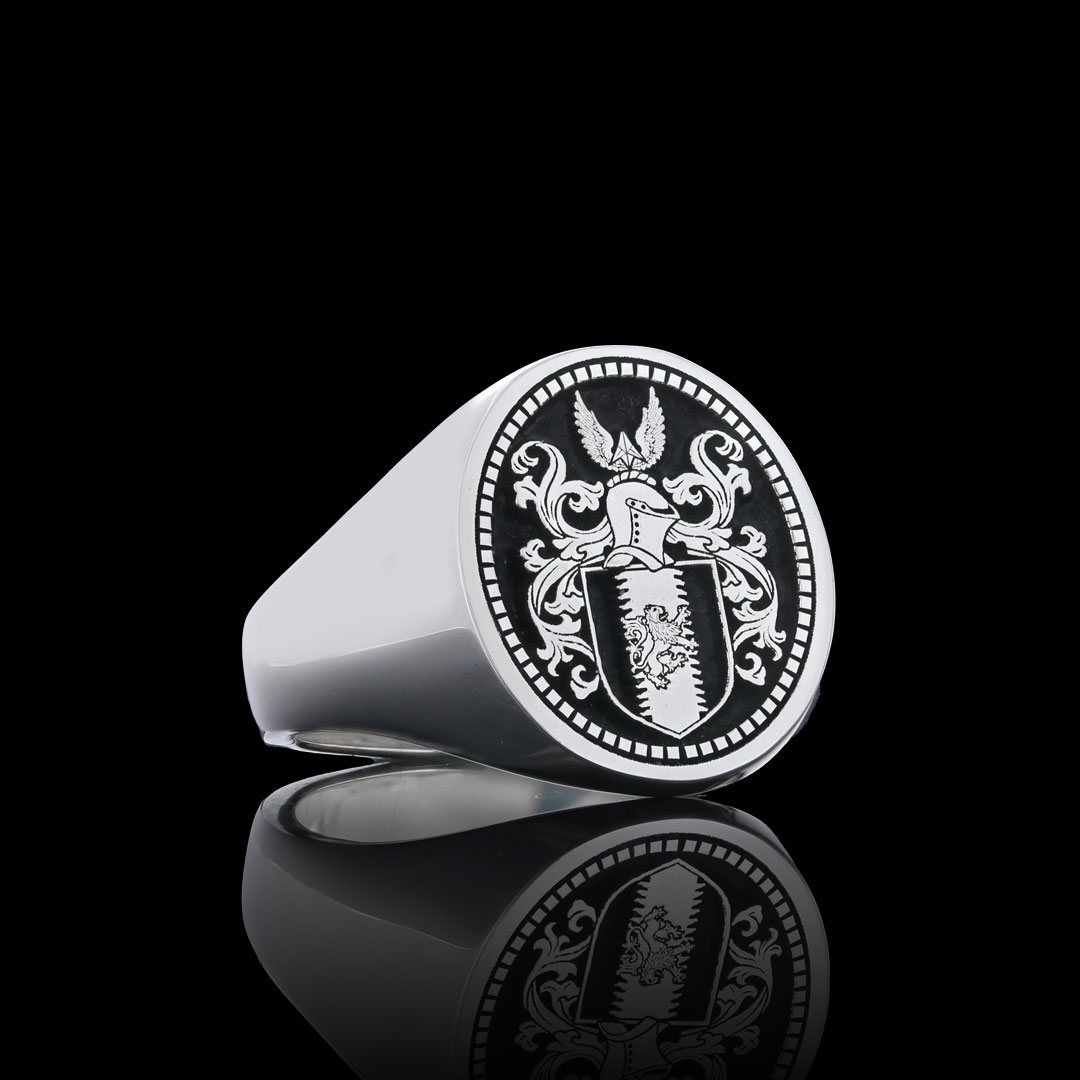
Crests and signet rings have gone together for centuries. Before envelopes and signatures, a gentleman pressed his ring into warm wax to seal a letter, and the crest was often the design he used. It still makes sense today. A crest is a single, self-contained image, so it engraves clearly on a small surface where a full coat of arms has to be simplified.
The crest alone is the most traditional choice for a signet ring. If the shield’s design is bold and simple, it can work well on its own. A larger face can carry the full coat of arms for a more formal look, and a Scottish crest badge, strap and buckle included, makes a fine ring for a clansman. If your family has no arms, initials or a symbol of your own carry just as much meaning.
At Clanmalier, every ring is made to order for the man who will wear it. Tell us your family name, share any arms or research you already have, or describe what you’d like the ring to say. We’ll research the heraldry, prepare a design for your approval and handcraft the ring.