
The colours of heraldry: metals, colours and furs explained
Heraldry works with a short list of colours, and each has its own name. Gold is “Or”, silver is “argent”, red is “gules”. Together they’re called tinctures, and they fall into three groups: two metals, a handful of colours, and the furs.
The palette is small for a practical reason. A coat of arms had to be recognised at a distance, often through dust or rain, so heralds kept to a few strong, flat colours that could never be mistaken for one another.
The two metals: Or and argent
Heraldry has only two metals. Or is gold, usually painted as yellow. Argent is silver, usually painted as white. Everything else on a shield is a colour or a fur.
Later heraldic writers gave the metals meanings. Or came to stand for generosity and high ideals, the colour of the sun. Argent stood for peace and sincerity, the colour of the moon. It’s worth knowing that medieval heralds rarely recorded why a family chose its colours. Most of these meanings were assigned centuries later, and a family’s colours were as likely to come from its overlord’s arms, or simply from what wasn’t already taken. They’re a pleasant tradition rather than a code.
The colours
Five colours make up nearly all of heraldry:
- Gules (red)
- The most common colour of all, traditionally linked with courage and military service.
- Azure (blue)
- Associated with loyalty and truth, the colour of the sky and the sea.
- Vert (green)
- Less common in early heraldry, and linked with hope, the land and renewal.
- Sable (black)
- Often misread as mourning. Heralds associated it with constancy and steadfastness, and gold or silver on a black field is one of the boldest combinations in heraldry.
- Purpure (purple)
- The rarest of the main colours, linked with royalty and justice, perhaps because purple dye was once so costly.
Two more, called the stains, appear only occasionally. Tenné is a tawny orange and sanguine (or murrey) a dark blood red. Old heraldry books claimed they were added to the arms of men who had disgraced themselves. There’s almost no evidence that ever happened, and the few arms that use them chose them for their rarity.
The rule of tincture
One rule governs how the tinctures are combined: metal should not be placed on metal, nor colour on colour. A gold lion can sit on a red or blue field, but not on a silver one. A red cross can sit on silver, but not on green.
The reason is contrast. Gold on silver, or red on blue, turns muddy at a distance. Keeping metal against colour made every coat of arms clear from across a field, and it’s still the mark of a well-designed shield. The rule has a few famous exceptions, the best known being the arms of the Kingdom of Jerusalem, gold crosses on silver, said to have been made deliberately unusual. But it holds for almost everything you’ll see.
The furs: ermine and vair
The furs come straight from what the medieval nobility wore. Real fur was a mark of rank, and in England sumptuary laws even set out who could wear which kind.
Ermine is the winter coat of the stoat, white except for the black tip of its tail. Furriers sewed the pelts together with the black tails dotted across them, and heraldry turned that into a white field scattered with small black ermine spots. It’s the fur of royal robes and peers’ coronation robes, and it carries that sense of high dignity. It has variations, too: ermines is white spots on black, erminois black spots on gold, and pean gold spots on black.
Vair comes from squirrel skins, blue-grey on the back and white underneath. Sewn together in rows, they made a pattern of alternating blue and white bell shapes, and that pattern became the heraldic fur. Vair is usually blue and white unless the blazon says otherwise.
Colour without colour: hatching
How do you show red, blue or green in a printed book or a black-and-white engraving? The answer is hatching, a system of lines and dots that became standard in the 17th century, so that arms could be printed and engraved accurately without any colour at all.
Each tincture has its own pattern. Or is shown by fine dots and argent is left plain. Gules is shown by vertical lines and azure by horizontal lines. Vert is diagonal lines running from top left to bottom right, purpure diagonals running the other way, and sable crossing horizontal and vertical lines. Anyone who knows the system can read the colours of a hatched drawing at a glance, which is why you’ll often see it in old armorials and on bookplates.
Colour on a signet ring
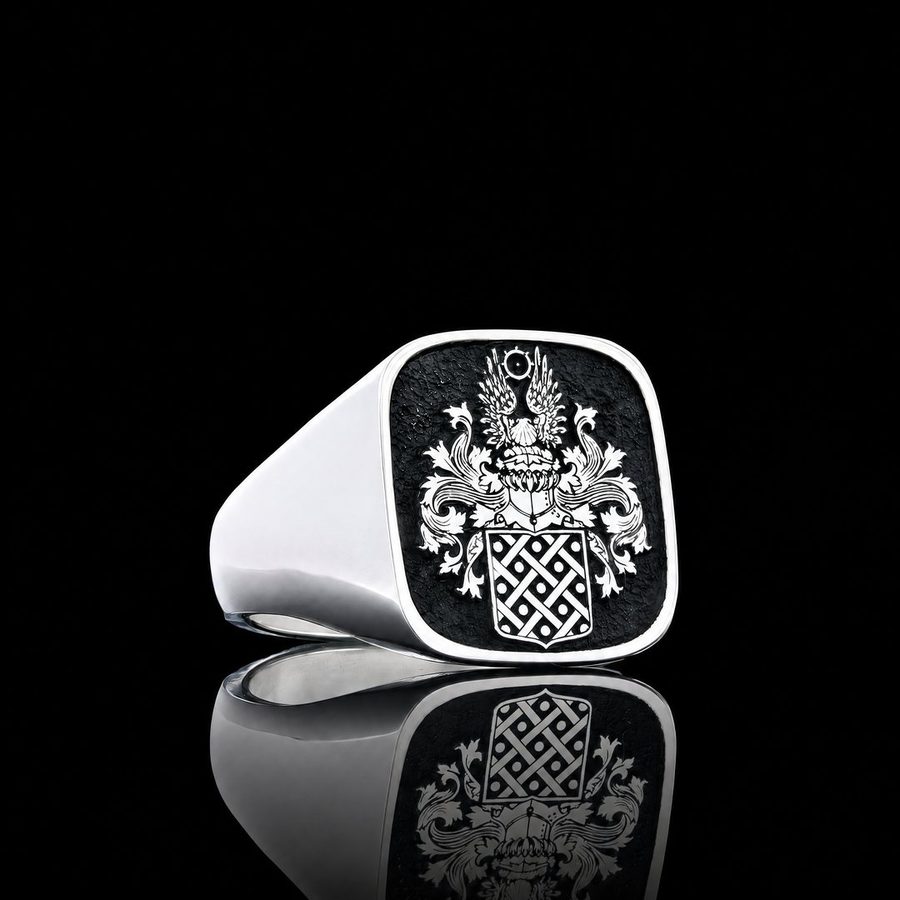
A signet ring is engraved in a single metal, so the design is carried by its shapes rather than its colours: every charge clear and in its proper place. That’s another reason the blazon matters, because it records the colours even when the ring can’t show them. The choice of metal can carry meaning too. Yellow gold is the natural match for arms where Or is the main metal, and sterling silver or white gold for arms built on argent.
At Clanmalier, every ring is made to order. Send us your coat of arms, or tell us your family name, and we’ll prepare a design for your approval and handcraft the ring.